Holiday Plants and Decorations: Lilies, Poinsettias and Tinsel
Which holiday plants and decorations are true emergencies for pets, which are overrated, and who to call if your dog or cat gets into one.
Published Last reviewed
Holiday decorating brings plants, bouquets, trees and shiny things into the house in the same few weeks, and pets investigate all of them. The risks are not equal. One group, true lilies, can kill a cat after a tiny exposure. Several famous "poisonous" plants usually cause no more than an upset stomach. And some of the most serious holiday emergencies come from things that are not poisonous at all, such as tinsel, ribbon and chewed cords. This guide sorts the season's hazards by how much they really matter, based on guidance from the FDA, the ASPCA Animal Poison Control Center, Pet Poison Helpline, Cornell University's Riney Canine Health Center and other veterinary references.
If your pet has already eaten something, stop reading and call your veterinarian, an emergency vet, the ASPCA Animal Poison Control Center at (888) 426-4435 or Pet Poison Helpline at (855) 764-7661. Both lines answer around the clock and may charge a consultation fee. Do not try to make your pet vomit unless a veterinarian tells you to.
Lilies are the real emergency for cats
The FDA calls lilies in the "true lily" (Lilium) and daylily (Hemerocallis) families "very dangerous for cats." Every part of the plant is toxic: stem, leaves, flowers, pollen and even the water in the vase. According to the FDA, eating a small piece of a leaf or petal, licking a few pollen grains off the fur while grooming, or drinking vase water can cause fatal kidney failure in less than 3 days. The toxin has not been identified, and it only affects cats. Dogs that eat these lilies may get a mild stomach upset but do not develop kidney failure.
The timeline matters. The FDA describes early signs (less activity, drooling, vomiting, loss of appetite) within 0 to 12 hours, signs of kidney damage at about 12 to 24 hours, and kidney failure within 24 to 72 hours. Early treatment greatly improves the outlook, but if treatment is delayed by 18 hours or more, the cat will generally have irreversible kidney failure. That is why a lily exposure is a call-now situation, even if your cat seems fine.
Lilies are a winter problem as well as a spring one. Pet Poison Helpline says holiday bouquets containing lilies are "far more worrisome" than poinsettias, and the ASPCA warns that many lilies typically found in holiday bouquets are highly toxic to cats. The FDA lists these as the most dangerous for cats:
- Asiatic lily (including hybrids)
- Daylily
- Easter lily
- Japanese show lily
- Oriental lily
- Rubrum lily
- Stargazer lily
- Tiger lily
- Wood lily
Not every plant called a lily works the same way. The FDA notes that lily-of-the-valley can cause a dangerous abnormal heart rhythm in cats and dogs, and gloriosa (flame) lily tubers can cause multi-organ failure. Calla lilies and peace lilies contain insoluble calcium oxalate crystals that irritate the mouth and throat, causing pawing at the face, drooling and vomiting that usually pass on their own. Peruvian lilies cause mild stomach upset.
The FDA's advice for cat households is simple: do not bring the dangerous lilies into the home. When you order flowers or receive a bouquet, check it and remove any lilies before it comes inside. If you think your cat touched one, call right away, and take the plant or a photo of it to the clinic so the veterinarian can identify it.
Poinsettia: less toxic than its reputation
The poinsettia has a scary reputation, but it is one of the milder holiday plants. The ASPCA's plant database lists it as toxic to dogs and cats but describes the signs as irritation of the mouth and stomach, "sometimes causing vomiting, but generally over-rated in toxicity." Pet Poison Helpline calls it only mildly toxic: the milky sap can cause drooling, vomiting and, rarely, diarrhea if eaten, and redness or itching if it touches the skin. Signs are usually self-limiting. It is still worth keeping the plant out of reach, and calling for advice if your pet has repeated vomiting or seems unwell.
Mistletoe, holly, amaryllis and other seasonal plants
Several other holiday plants fall between the poinsettia and the lily. The ASPCA notes that eating any plant material can cause vomiting and stomach upset, and that its plant list covers the most frequently encountered plants rather than every plant. When in doubt, call.
| Plant | What the sources say |
|---|---|
| American mistletoe | ASPCA lists vomiting, diarrhea, difficulty breathing, a low heart rate and, rarely, low blood pressure. Pet Poison Helpline says small amounts usually cause only stomach upset, while large amounts can cause low blood pressure and a stumbling gait. Store-bought sprigs often have plastic berries that could block the gut if swallowed. |
| Holly | ASPCA lists vomiting, diarrhea and depression and calls the leaves and berries low toxicity. Pet Poison Helpline adds that the spiky leaves can injure the lips and gums. |
| Amaryllis | ASPCA lists vomiting, depression, diarrhea, abdominal pain, drooling, loss of appetite and tremors. Pet Poison Helpline says the bulb is more toxic than the flowers and leaves. |
| Paperwhites (narcissus) | ASPCA lists vomiting, drooling and diarrhea, with convulsions, low blood pressure, tremors and heart rhythm problems after large amounts. The bulbs are the most poisonous part, so store forcing bulbs out of reach. |
| Christmas rose (hellebore) | ASPCA lists drooling, abdominal pain, diarrhea and depression. |
| Christmas cactus | ASPCA lists it as non-toxic to dogs and cats. Pet Poison Helpline notes mild vomiting or diarrhea can still occur. |
The ASPCA suggests keeping floral decorations out of reach or swapping in artificial versions.
Christmas trees: water, needles and stability
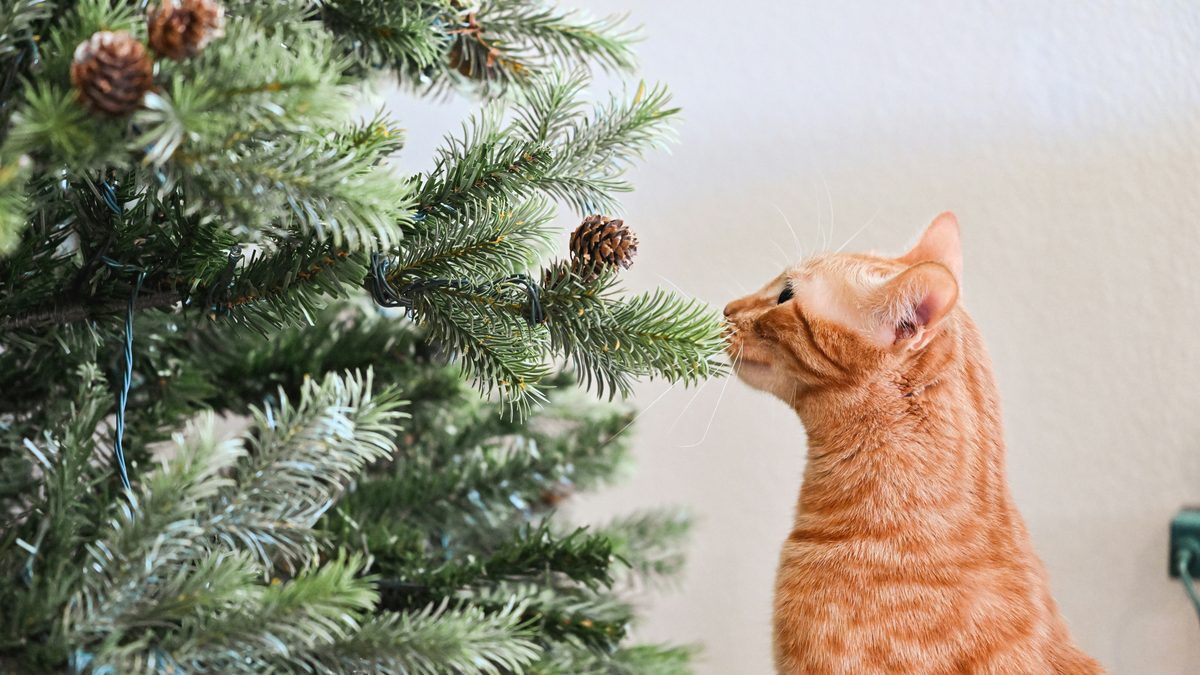
Stability. The ASPCA advises securing the tree tightly so it cannot tip over onto a pet. Pet Poison Helpline recommends anchoring a tree at both the top and the bottom if you have a climbing cat.
Water. The ASPCA calls tree-stand water a breeding ground for bacteria that can cause nausea and diarrhea, and recommends covering it or blocking access. Pet Poison Helpline says drinking tree water usually causes only mild vomiting and diarrhea, even when a preservative has been added, and Cornell's Riney Canine Health Center notes that tree water may contain harmful bacteria or chemicals. A tight tree skirt or a covered stand helps with both.
Needles and sap. Pet Poison Helpline says fir, spruce and pine needles can irritate the mouth and stomach, and large amounts can block or even puncture the digestive tract because needles do not digest well. Cornell University's Riney Canine Health Center gives the same warning for dogs. Pet Poison Helpline adds that cats are sensitive to pine oils, so wash sap off a cat's fur before the cat grooms it off. An artificial tree avoids sap, needles and tree water, although chewed artificial material can also cause stomach upset or a blockage.
Ornaments. The ASPCA warns that shards of glass or plastic ornaments can damage the mouth and digestive tract. Salt-dough ornaments are a separate hazard: the ASPCA and Cornell both warn that they can cause salt poisoning, a potentially life-threatening electrolyte imbalance, and the ASPCA notes this is true even when the ornaments are dry. Hang breakable and edible ornaments high, and keep wrapped food gifts off the floor, since pets can smell what is inside.
Tinsel, ribbon and string
Tinsel is not poisonous in the usual sense, but it can be deadly for cats. Pet Poison Helpline explains that tinsel, ribbon, yarn and thread can become a "linear foreign body": one end wraps around the base of the tongue or anchors in the stomach, and as the intestines contract, the strand can slowly saw through the tissue. VCA Animal Hospitals explains that the intestines bunch up along the strand and can tear, leaking intestinal contents into the abdomen (peritonitis), which can be life-threatening. Treatment usually means abdominal surgery. The ASPCA lists severe vomiting, dehydration and an obstructed digestive tract as possible results, and Cornell's Riney Canine Health Center warns that swallowed tinsel and garland can cause an intestinal obstruction in dogs.
- Skip tinsel entirely if you have a cat, as both the ASPCA and Pet Poison Helpline recommend.
- Gather ribbon and bows as gifts are opened, and store wrapped presents out of reach until the big day. Pet Poison Helpline notes that cats with a ribbon obstruction may keep eating and drinking for a while, which can hide the problem.
- Pet Poison Helpline also warns that some tinsel and garland may contain zinc, which can cause a dangerous anemia if eaten.
- If you see string, ribbon or tinsel hanging from your pet's mouth, do not pull it. The Merck Veterinary Manual explains that it could be caught in the intestines and pulling could tear them. Go to a veterinarian right away.
Candles, cords, batteries and other decorations
- Candles. The ASPCA reminds owners that a curious cat or a wagging tail can knock over an unattended candle, burning the pet or starting a fire. Keep lit candles out of reach and never leave them alone.
- Electrical cords. The ASPCA warns that a chewed wire can deliver a potentially lethal shock, and Cornell lists electrical burns and electrocution. Pet Poison Helpline notes that cats who chew through light strands may have trouble breathing and burns in the mouth, and should be seen by a veterinarian immediately. Use cord covers and unplug lights when no one is home.
- Batteries. New toys and remotes mean spare batteries. Pet Poison Helpline explains that a punctured or swallowed battery can leak corrosive material that injures the mouth and other tissues, and that button and lithium batteries can cause burns where they lodge. It says a pet that swallowed a battery should not be made to vomit and needs a veterinarian right away.
- Snow globes. Pet Poison Helpline says certain snow globes have been found to contain ethylene glycol, the toxic ingredient in antifreeze, and the ASPCA warns that the sweet smell of a broken globe can attract pets. Pet Poison Helpline notes the concentration is generally quite low, but a pet near a broken globe still warrants a call, and the spill needs a thorough cleanup.
- Liquid potpourri and scented oils. Pet Poison Helpline warns that simmering liquid potpourri can cause mouth burns, fever, breathing difficulty and tremors in cats after only a few licks, and that concentrated pine oil is highly toxic, especially to cats.
- Guests' bags. The ASPCA suggests asking overnight guests to keep their medications in a closed cabinet rather than an open bag or suitcase.
Holiday food brings its own list of hazards, from chocolate and xylitol to fatty scraps and bones. See 10 foods that are toxic to dogs and our Thanksgiving pet safety guide. For ice melt, antifreeze and cold-weather risks, read winter and cold-weather pet safety.
Who to call
Save these numbers in your phone before the holidays, along with your regular clinic and the nearest 24-hour hospital:
- Your veterinarian during office hours.
- An emergency veterinary hospital after hours. Browse emergency vets on Furford, or by city, such as Phoenix, Atlanta, Denver or Houston, and confirm hours by phone.
- ASPCA Animal Poison Control Center: (888) 426-4435, available 24 hours a day, 365 days a year. A consultation fee may apply.
- Pet Poison Helpline: (855) 764-7661, available 24/7. Its website listed an $89 per-incident fee, including follow-up consultations, when we checked in October 2026.
When you call, have the plant or product name (or a photo of it), how much may be missing, when it happened and your pet's approximate weight. Our pet emergency information page has more on handling an emergency, and a stocked pet first aid kit keeps these numbers in one place. More seasonal guides are collected in our pet safety hub.
Frequently asked questions
Are poinsettias poisonous to cats?
Poinsettias are listed as toxic to cats and dogs, but the effects are usually mild. The ASPCA describes irritation of the mouth and stomach, sometimes with vomiting, and calls the plant generally over-rated in toxicity. Pet Poison Helpline says signs such as drooling and vomiting are usually self-limiting. Call your veterinarian or a poison control line if your cat keeps vomiting or seems unwell.
Which lilies are dangerous to cats?
True lilies (Lilium) and daylilies (Hemerocallis) can cause fatal kidney failure in cats. The FDA lists Asiatic, daylily, Easter, Japanese show, Oriental, rubrum, stargazer, tiger and wood lilies as the most dangerous. Every part counts, including pollen and vase water. Lily-of-the-valley and gloriosa lily are dangerous for a different reason, while calla, peace and Peruvian lilies usually cause milder mouth or stomach irritation. Any suspected exposure to a true lily or daylily needs a call to a veterinarian right away.
Is Christmas tree water bad for pets?
It is usually not a poisoning emergency, but it is worth blocking. The ASPCA says stand water can grow bacteria that cause nausea and diarrhea, and Pet Poison Helpline says drinking it typically causes mild vomiting and diarrhea even when a preservative has been added. Cornell University's Riney Canine Health Center adds that tree water may contain harmful bacteria or chemicals. A covered stand or tight tree skirt keeps pets out of it.
My cat ate tinsel. What should I do?
Call your veterinarian or an emergency clinic now, even if your cat seems fine. Tinsel and ribbon can act as a linear foreign body that anchors in the mouth or stomach and damages the intestines, and cats may keep eating for a while before signs appear. If you can see a strand hanging from the mouth, do not pull it: the Merck Veterinary Manual warns that pulling could tear the intestines. Do not try to make your cat vomit.
Is a Christmas cactus safe for pets?
The ASPCA lists Christmas cactus as non-toxic to dogs and cats. Pet Poison Helpline notes that eating it can still cause mild vomiting or diarrhea, as eating many plants can, but serious toxicity is not expected. It is one of the safer choices for a holiday plant in a home with pets.
Find help near you
Listings come from public business information. Call ahead to confirm services, prices and hours.
Sources
We checked this article against these sources. Links open the original pages.
- FDA: Lovely lilies and curious cats, a dangerous combination (accessed October 13, 2026)
- ASPCA: Holiday safety tips (accessed October 13, 2026)
- ASPCA Animal Poison Control: Toxic and non-toxic plants (accessed October 13, 2026)
- ASPCA plant database: Poinsettia (accessed October 13, 2026)
- ASPCA plant database: American mistletoe (accessed October 13, 2026)
- ASPCA plant database: Holly (accessed October 13, 2026)
- ASPCA plant database: Amaryllis (accessed October 13, 2026)
- ASPCA plant database: Daffodil (narcissus, paper white) (accessed October 13, 2026)
- ASPCA plant database: Christmas rose (accessed October 13, 2026)
- ASPCA plant database: Christmas cactus (accessed October 13, 2026)
- ASPCA Animal Poison Control Center (accessed October 13, 2026)
- Pet Poison Helpline: Winter holiday pet poison tips (accessed October 13, 2026)
- Pet Poison Helpline: Deck the halls with holiday plants, but are they toxic? (accessed October 13, 2026)
- Pet Poison Helpline: Holiday pet poison myths (accessed October 13, 2026)
- Pet Poison Helpline: Cats and Christmas trees (accessed October 13, 2026)
- Pet Poison Helpline: Tinsel (accessed October 13, 2026)
- Pet Poison Helpline: Batteries (accessed October 13, 2026)
- Pet Poison Helpline (24/7 line and fee) (accessed October 13, 2026)
- Cornell University Riney Canine Health Center: Holiday hazards for dogs (accessed October 13, 2026)
- VCA Animal Hospitals: Linear foreign body in cats (accessed October 13, 2026)
- Merck Veterinary Manual: Minor injuries and accidents (swallowed objects) (accessed October 13, 2026)
- Pet Poison Helpline: Poinsettia (accessed October 13, 2026)
- Pet Poison Helpline: Mistletoe (accessed October 13, 2026)
- Pet Poison Helpline: Holly (accessed October 13, 2026)
- Pet Poison Helpline: Pine oil (accessed October 13, 2026)